Take part

Track your habits, and contribute to research along the way.

The Health Habit Hub turns small daily steps into visible patterns. It is free, it treats your data with care, and every entry helps science understand healthy habits a little better.12

Download on the App StoreGet it on Google Play
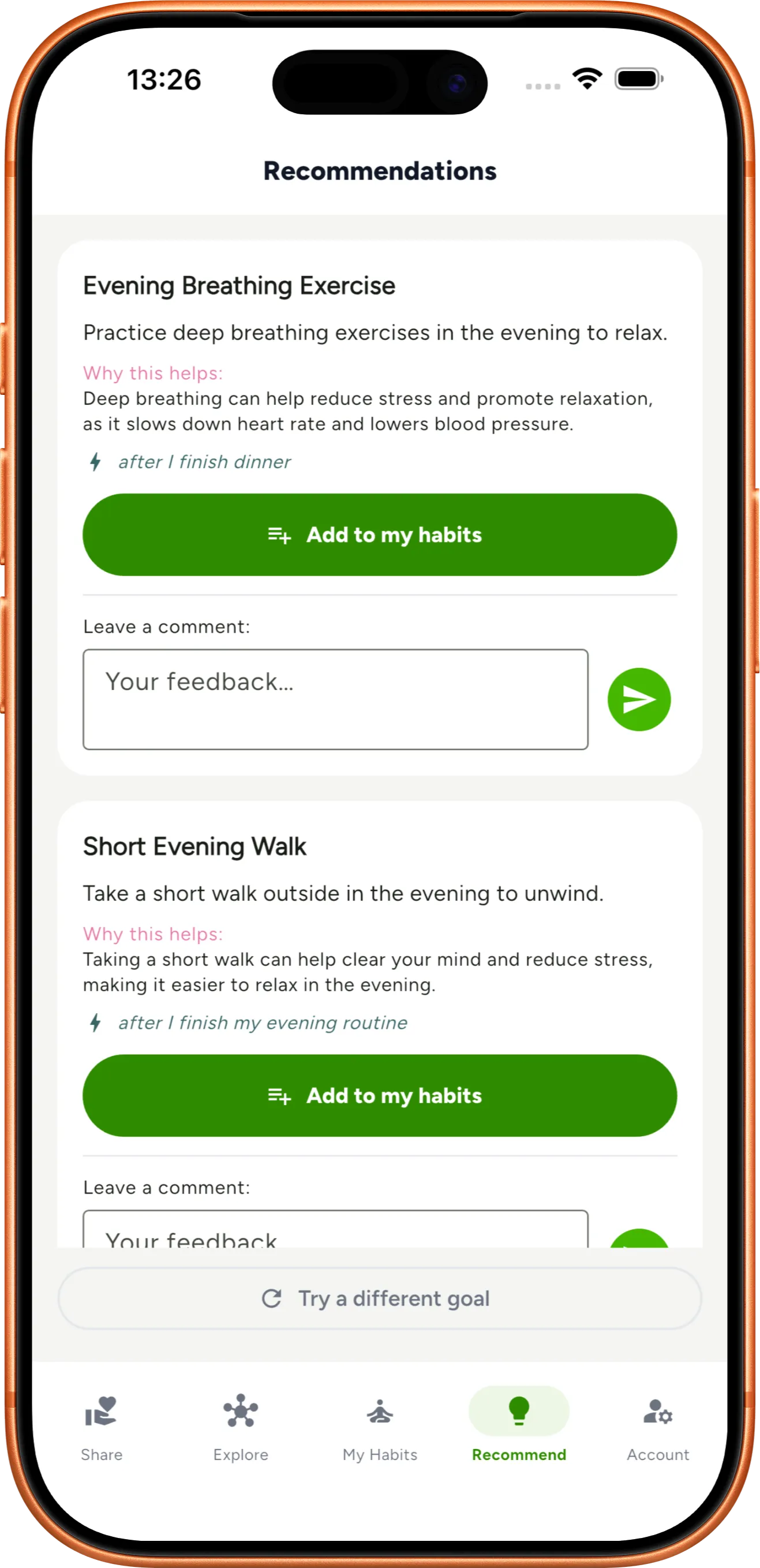
Suggestions that fit you
1

Suggestions that fit you

Instead of generic advice you get ideas grounded in behavioural science, each with a plain rationale and a one-tap way to try it.34567
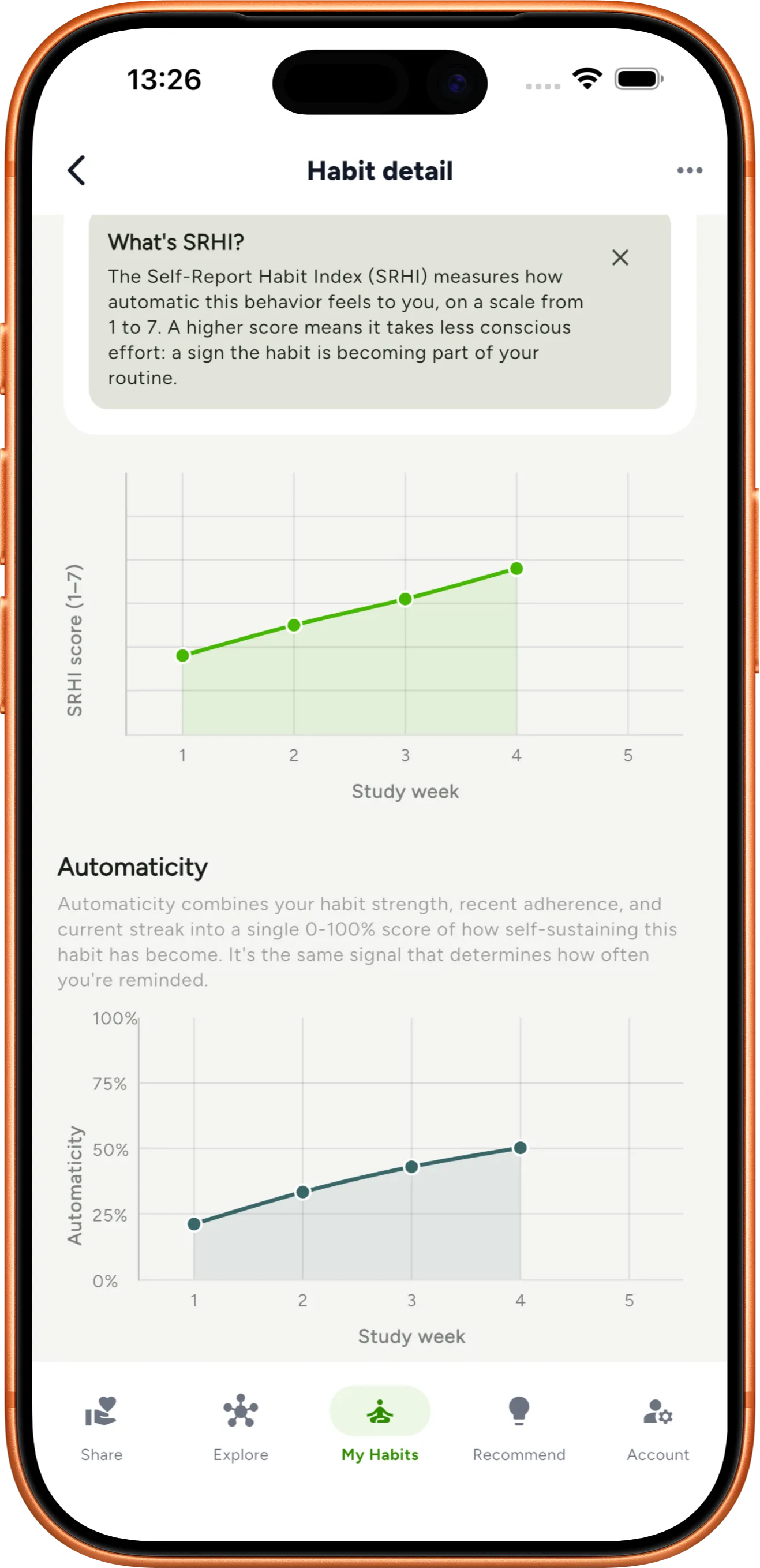
Progress you can measure
2

Progress you can measure

For each habit, established measures like the Self-Report Habit Index are tracked over time, so you can watch an intention turn into a genuine routine.891011
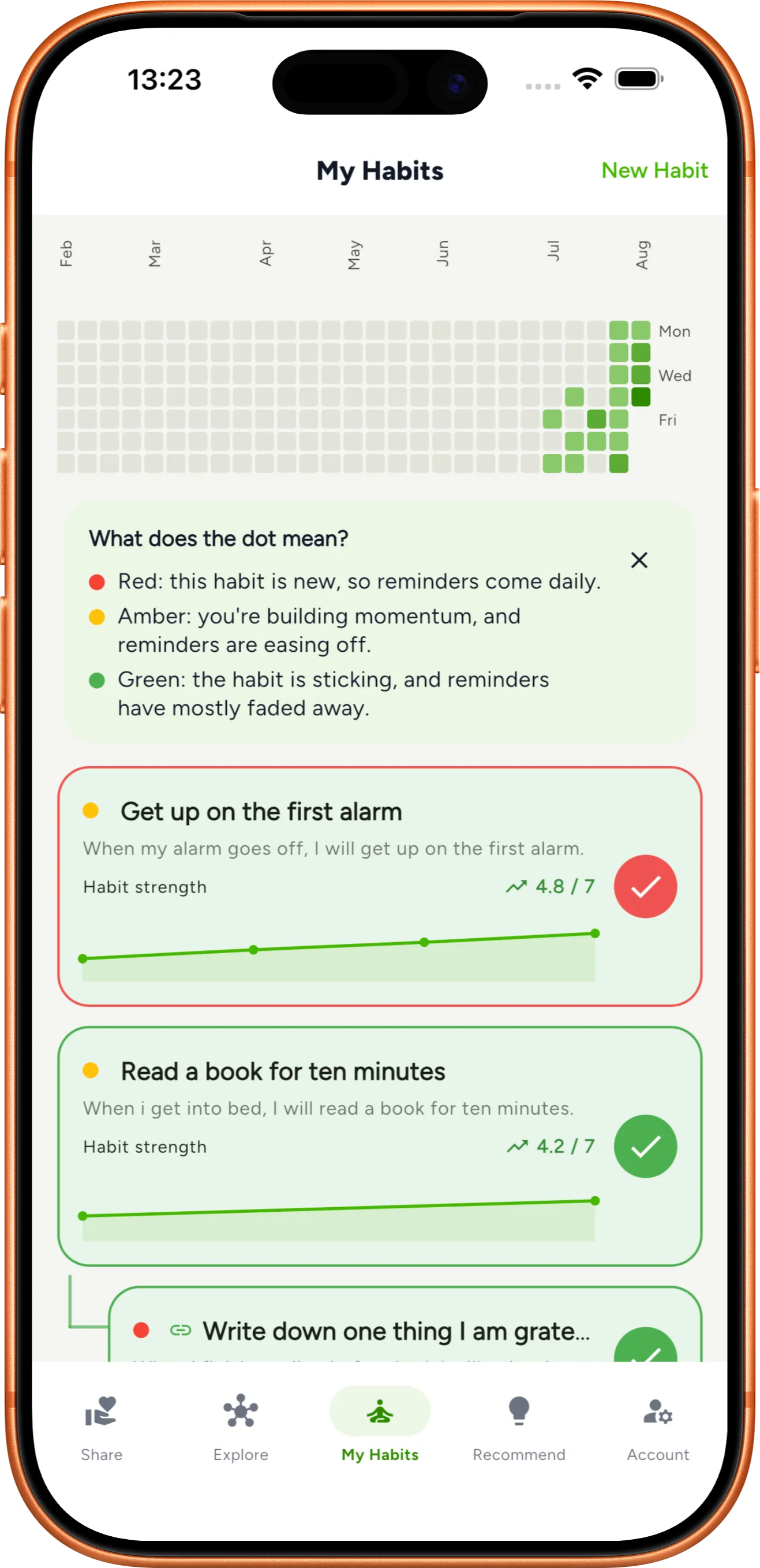
Watch habits become second nature
3

Watch habits become second nature

A calendar shows at a glance how consistent you have been. Reminders quietly fade once a habit sticks, so the app never nags you forever.12131415
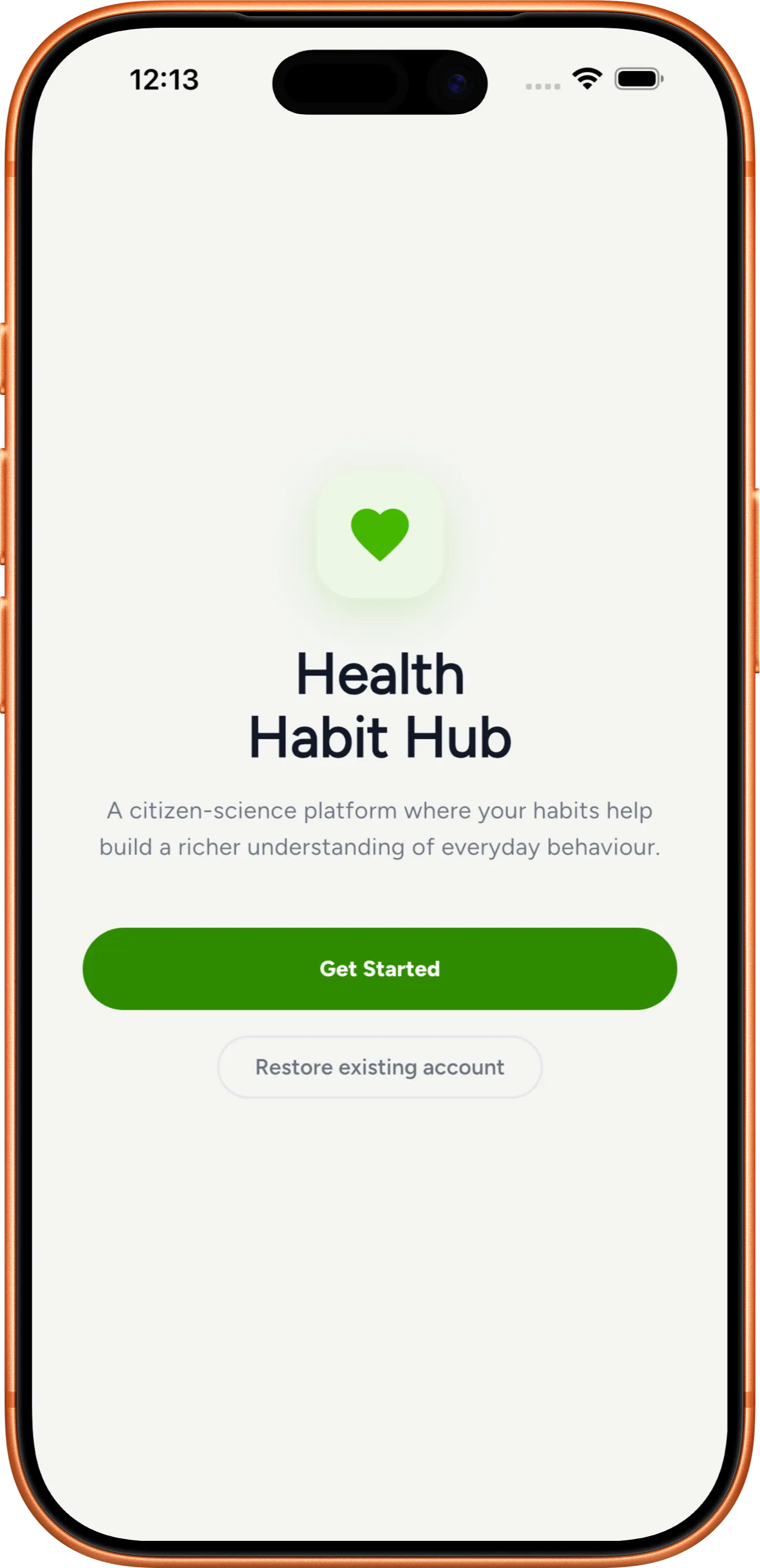
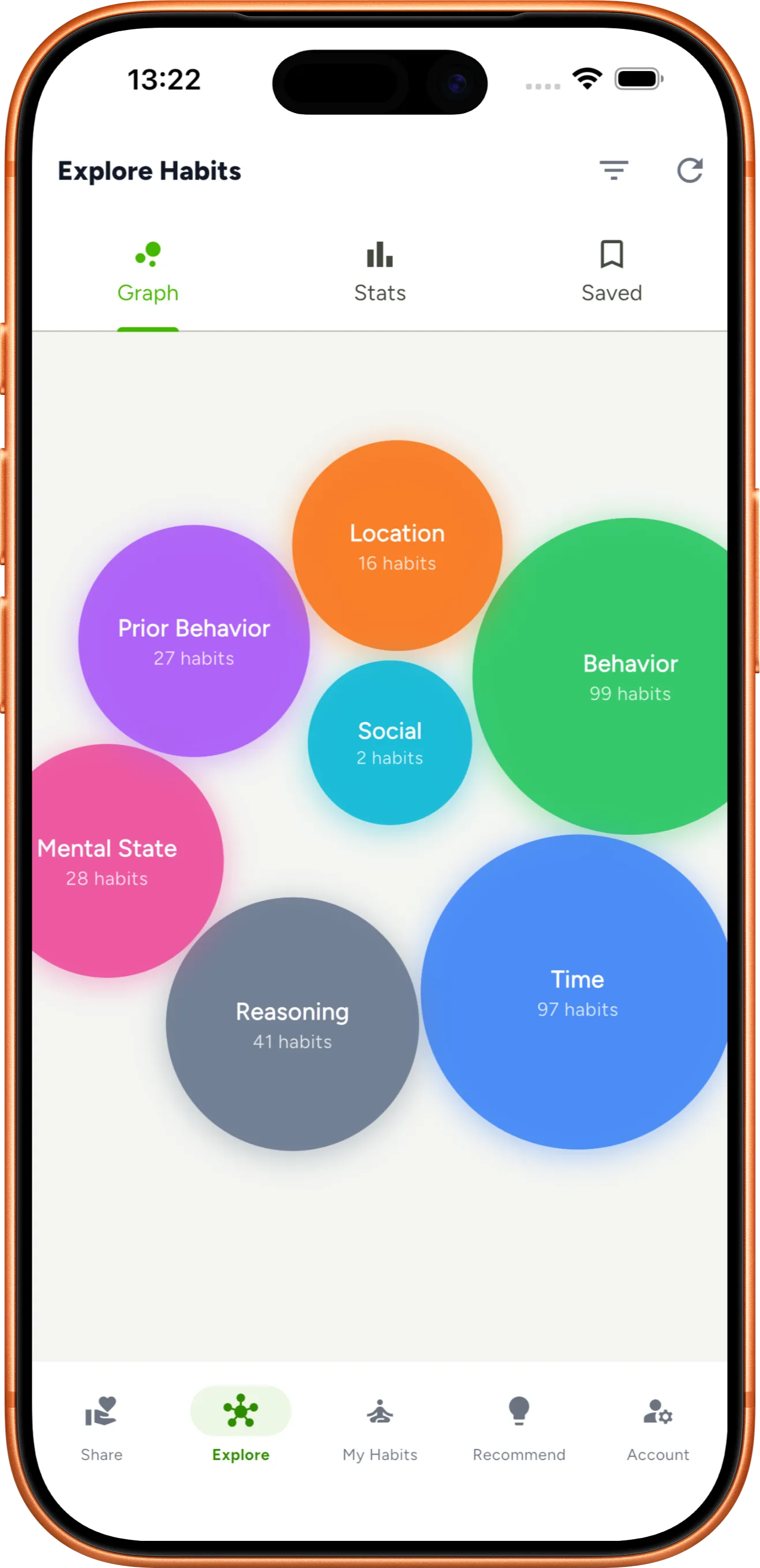
Explained in a single screen
4

Explained in a single screen

No long onboarding, no endless forms. A clear promise, a way in, and you are set up in about a minute.
You are not on your own
How to take part

In three calm steps.

1

Get the app

Download it from the App Store or Google Play, or simply open it in your browser.

2

Consent

Read the consent and the short guide. Everything is transparent and you can withdraw at any time.

3

Begin

Record your habits and watch your progress grow.

Your data belongs to you

Sign-in runs over secured single sign-on, and storage follows GDPR on European infrastructure. What happens with your data is written in plain language in the privacy policy and the consent, with no fine print.

Download on the App StoreGet it on Google Play

Sources

  1. 1Harkin, B., Webb, T. L., Chang, B. P. I., Prestwich, A., Conner, M., Kellar, I., Benn, Y., & Sheeran, P. (2016). Does monitoring goal progress promote goal attainment? A meta-analysis of the experimental evidence. Psychological Bulletin, 142(2), 198–229. https://doi.org/10.1037/bul0000025
  2. 2Michie, S., Abraham, C., Whittington, C., McAteer, J., & Gupta, S. (2009). Effective techniques in healthy eating and physical activity interventions: A meta-regression. Health Psychology, 28(6), 690–701. https://doi.org/10.1037/a0016136
  3. 3Michie, S., Richardson, M., Johnston, M., Abraham, C., Francis, J., Hardeman, W., Eccles, M. P., Cane, J., & Wood, C. E. (2013). The behavior change technique taxonomy (v1) of 93 hierarchically clustered techniques: Building an international consensus for the reporting of behavior change interventions. Annals of Behavioral Medicine, 46(1), 81–95. https://doi.org/10.1007/s12160-013-9486-6
  4. 4Michie, S., West, R., Finnerty, A. N., Norris, E., Wright, A. J., Marques, M. M., Johnston, M., Kelly, M. P., Thomas, J., & Hastings, J. (2021). Representation of behaviour change interventions and their evaluation: Development of the Upper Level of the Behaviour Change Intervention Ontology (Version 2). Wellcome Open Research, 5, Article 123. https://doi.org/10.12688/wellcomeopenres.15902.2
  5. 5Noar, S. M., Benac, C. N., & Harris, M. S. (2007). Does tailoring matter? Meta-analytic review of tailored print health behavior change interventions. Psychological Bulletin, 133(4), 673–693. https://doi.org/10.1037/0033-2909.133.4.673
  6. 6Tintarev, N., & Masthoff, J. (2007). A survey of explanations in recommender systems. In 2007 IEEE 23rd International Conference on Data Engineering Workshop (pp. 801–810). IEEE. https://doi.org/10.1109/ICDEW.2007.4401070
  7. 7Reinsch, F., Weimann, T., & Stark, J. (2024). Tailoring health: Contextual variables in health recommender systems. In Proceedings of the 6th International Workshop on Health Recommender Systems (HealthRecSys 2024) (CEUR Workshop Proceedings, Vol. 3823, pp. 2–15). CEUR-WS.org. https://ceur-ws.org/Vol-3823/1_Reinsch_tailoring_159.pdf
  8. 8Verplanken, B., & Orbell, S. (2003). Reflections on past behavior: A self-report index of habit strength. Journal of Applied Social Psychology, 33(6), 1313–1330. https://doi.org/10.1111/j.1559-1816.2003.tb01951.x
  9. 9Sheeran, P., & Webb, T. L. (2016). The intention–behavior gap. Social and Personality Psychology Compass, 10(9), 503–518. https://doi.org/10.1111/spc3.12265
  10. 10Gollwitzer, P. M. (1999). Implementation intentions: Strong effects of simple plans. American Psychologist, 54(7), 493–503. https://doi.org/10.1037/0003-066X.54.7.493
  11. 11Lally, P., & Gardner, B. (2013). Promoting habit formation. Health Psychology Review, 7(Suppl. 1), S137–S158. https://doi.org/10.1080/17437199.2011.603640
  12. 12Wood, W., & Rünger, D. (2016). Psychology of habit. Annual Review of Psychology, 67(1), 289–314. https://doi.org/10.1146/annurev-psych-122414-033417
  13. 13Lally, P., van Jaarsveld, C. H. M., Potts, H. W. W., & Wardle, J. (2010). How are habits formed: Modelling habit formation in the real world. European Journal of Social Psychology, 40(6), 998–1009. https://doi.org/10.1002/ejsp.674
  14. 14Stawarz, K., Cox, A. L., & Blandford, A. (2015). Beyond self-tracking and reminders: Designing smartphone apps that support habit formation. In Proceedings of the 33rd Annual ACM Conference on Human Factors in Computing Systems (pp. 2653–2662). Association for Computing Machinery. https://doi.org/10.1145/2702123.2702230
  15. 15Reinsch, F., Weimann, T., & Stark, J. (2025). From instant cues to fading views: Piloting just-in-time and fading strategies in digital habit formation. In AMCIS 2025 Proceedings. Association for Information Systems. https://aisel.aisnet.org/amcis2025/health_it/sig_health/5